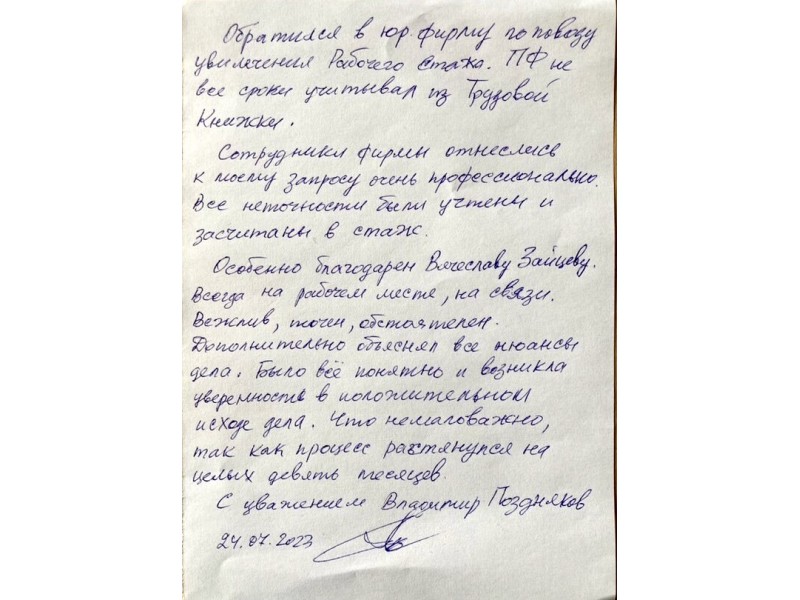


Pension Fund Refuses to Count Employment Record Due to Errors in Employment Book
Incorrect entries in employment record books are a fairly common problem in pension cases. Usually, a person becomes aware of such errors only after the Pension Fund considers an application for a pension. In particular, the Pension Fund authorities may refuse to include periods of employment in the insurance record if the relevant entries in the employment record book were not properly completed. This may affect not only the amount of the pension but also a person’s entitlement to a pension in general.
Mr. Pozdniakov approached us with precisely this problem after the Pension Fund refused to include almost seven years of his employment in his insurance record. The reason was that three entries in his employment record book did not specify the numbers and dates of the orders concerning his hiring and dismissal. In addition, another period of employment was excluded because the employer had failed to pay the unified social contribution.
Mr. Pozdniakov was unable to contact his employer to obtain an additional certificate because the disputed periods of employment related to an enterprise located in the temporarily occupied territory of Ukraine.
Having analysed the Pension Fund’s refusal and the client's documents, we decided to file a claim with the court. Our legal position was based on the following arguments.
First, an employee cannot be held responsible for the accuracy and completeness of the employer’s accounting and personnel records, including improper maintenance and completion of the employment record book and other documentation. Therefore, the employer’s failure to properly maintain such records cannot constitute grounds for depriving an employee of the constitutional right to social protection when determining entitlement to an old-age pension.
Accordingly, certain deficiencies in the completion of an employment record book cannot constitute grounds for excluding the relevant period of employment when calculating a person’s insurance record for pension purposes.
Second, under the applicable legislation, the obligation to pay insurance contributions, as well as liability for late or incomplete payment of such contributions, is imposed on the policyholder, namely the employer.
Therefore, an employee should not bear responsibility for the employer-policyholder’s failure to properly fulfil its obligation to pay insurance contributions. Consequently, an employer’s outstanding debt in respect of insurance contributions cannot constitute grounds for excluding the relevant periods of a person’s employment with that employer from the insurance record.
All our arguments were supported by the relevant case law of the Supreme Court.
Having considered the case, the court of first instance fully supported our position and confirmed that the Pension Fund had unlawfully refused to include the disputed periods of Mr. Pozdniakov’s employment in his insurance record. The court also ordered the Pension Fund authority to include the disputed periods in his insurance record and recalculate his pension accordingly.
The Pension Fund did not exercise its right to appeal the judgment. As a result, the judgment entered into legal force after the expiry of the 30-day appeal period. The Pension Fund subsequently complied with the judgment, recalculated Mr. Pozdniakov’s pension and paid him the pension arrears resulting from the previous incorrect calculation.
The court judgment is available at the following link: https://reyestr.court.gov.ua/Review/109566659.